Flowering can take a fair amount of energy from the pumpkin plant so I hit both plants with a very small amount of foliar RAW Bloom (3-12-12) this evening. A little nudge with phosphorous and potassium can encourage flowering. However, too much can change up the chemistry and give you the opposite effect.
I have to admit I'm getting a little impatient right now. Both of my plants have females on the main vine at around the 10 foot mark. However, I'd like to see my plants bigger before I pollinate a keeper. I'll pollinate everything because you never know what you'll get and what will take, but ideally I'd like to pollinate at around 14-16' range on the main this year. I'd also like to pollinate by the 24th if possible. Problem with that is that once a female shows up, depending on the weather (females seem to develop faster when it is hot out), it is typically 7-10 days until a female flower opens. That means I need females to show up tomorrow or the next day on the main vine.
When it comes to females it can really be hit or miss as to when they show up. When a plant is ready they will sometimes just start popping up all over the place. Some plants might just get a few females on it at all, so you take what you can get. I think a lack of flowering is sometimes a genetic thing and other times it is because of too much nitrogen in the soil or other imbalances. Nitrogen will encourage vining and the plant can't just can't switch to flowering mode if there is too much.
One thing you have to look at when it comes to newly pollinated pumpkins is their position on the vine. Ideally you want that pumpkin to be in a place where that vine won't get kinked or crushed by the pumpkin as it grows. It is hard to remember, but that pumpkin could be 4-5 feet across at the end of the season and if the pumpkin isn't positioned well, you will have all kinds of problems with the pumpkin trying to pick itself off the vine if it isn't positioned properly.

Learn How to Grow a Giant Pumpkin. Competition Giant Pumpkin Seeds, Fertilizers & Growing Tips from Jamie 'The Pumpkin Man'. The Most Read Extreme Gardening, Pumpkin Blog in the World.
Tuesday, June 16, 2015


Monday, June 15, 2015
Brix Testing of Garden Plants Sap
In addition to the EC testing I started doing this year, I am also now doing a brix testing. This is kind of new to me so I'll let you know what I find as the season goes on. There is a gardening expert that I talked with that said he typically see brix go down as EC numbers drop. I'm hoping that a combination of EC testing with brix testing will give me a combination of telling me not only what is happening in the soil, but what is happening in the plant. With that information I can make adjustments in how and when I fertilize the plant.
Brix basically looks at the thickness of the sap of the pumpkin plant. It doesn't tell you what is in the sap and what needs to be added, but the assumption is that thicker sap means more nutrients are in the sap and as a result a healthier plant. By no means is brix testing completely scientific in its measurement, but frankly there are problems with many of the different types of tests that we do. As long as you understand the variances and weaknesses then you can make adjustments accordingly.
Today is the first time I've tried doing brix testing. My hope is that over time and enough testing that I can start to see patterns in the results which will tell me how what I'm doing is effecting the plant. For example, if I fertilize, will I see an increase in the brix in the few days following? Also, when I see the EC readings go up and down will the brix follow the same or similar pattern. If I can find the patterns then I should be better able to refine my fertilizer program and hopefully that will translate to a bigger pumpkin later in the year.
Gave the plants some compost tea in the morning and then then some foliar fish this evening.
Sunday, June 14, 2015
Insectoside Time for the Pumpkin Plants
I don't prefer to use insecticides but last year I lost both plants to yellow vine diseases which is spread by cuke beetles and and squash bugs. A couple of years before that I lost a very nice 1789 Wallace plant to the same disease. Last season I only saw one squash bug in the patch all season and didn't see any cuke beetles. It just takes one infected squash bug to end a season early however.
Last season I sprayed, but this season I'm going to spray and also add a systemic to the mix. That should give me better coverage. For the contactants I only spay in the evening, to give the bees a better change. With the rains mostly done and warmer weather happening I suspect we are going to see a lot more bugs coming out.
Last season I sprayed, but this season I'm going to spray and also add a systemic to the mix. That should give me better coverage. For the contactants I only spay in the evening, to give the bees a better change. With the rains mostly done and warmer weather happening I suspect we are going to see a lot more bugs coming out.
Crocs in the garden
I missed the whole croc revolution 10 years ago by choice. Didn't like the looks of them. Recently picked some up for use in the pumpkin patch. I have to say, they are excellent for that.
Saturday, June 13, 2015
Giant Pumpkin Fertilizer Program: Part 2

Looking at the program below, you'll see that in early May I'm trying to get beneficial biology going in the soil early to help protect the roots and add beneficial bacteria and fungi that will help feed the plant. In the 2nd week I'm also adding a touch of RAW Phosphouous to the soil. This particular type of phosphorous, when added in the first three weeks after transplant has been shown to increase root mass by 20%. Who wouldn't want that?
You'll not that in may I'm not giving much in the way of fertilizers to the plant at this point. What I am giving is being spoon feed in small quantities. The soil should be built up enough to properly feed the plant. You'll also note the kelp I've giving to the plant roots. This will help build the roots system with different plant hormones that comes from kelp. The main focus of May should be on the roots of the plant.
In June I'm still spoon feeding the plant but adding a little nitrogen. The RAW Nitrogen and RAW ominA will help support vine growth and in June it is all about the vines. A good portion of the nitrogen the plant is going to take up in its live is going to be during the month of June. RAW ominA is a very interesting product that I just learned about this year. Not only is it a nitrogen source, but the amino acids that are include in ominA can help open calcium ion pathways by the thousands and even millions. More calcium in the plant means a healthier plant that is more disease and insect resistent. Since I have soil that is a little high in potassium, which is antagonistic to the uptake of calcium, I was thrilled to learn what ominA could help me do in my patch.

In the past I've kind of held off on potassium around pollination time. Some have suggested it can cause the fruit to abort. That could be true, but I also want to grow a pumpkin as big as I possibly can so I'm going to give the plant foliar TKO around pollination time to help the fruit and flowering of the plant and then after pollination spoon feed with a little potassium.
About 24-28 days after pollination that pumpkin should really start to take off. By this time the plant has hopefully grown to a descent size and some of the side vines on the plant should be terminated. You should pollinate the pumpkin on the main vine after 9 feet (14 feet would be closer to ideal) and the side vines and main vine should have grown big enough that there are enough leaves and root system to support the growth of the pumpkin. At about day 28-32 the vines on the plant should really start to slow down in growth as the pumpkin becomes the main sink of the plant (aka black hole).
In July and August the fertilizer program is about supporting the pumpkin growth. The plant is going to pull up a lot of potassium from the soil. Like I said before, my soil is a touch high in potassium, but even with that the rhizosphere around the root hairs can only reach so much potassium and as that pumpkin rings the dinner bell, we will want to make sure the plant has what it needs. This is where some foliar applications can be helpful.
You'll note that each month I'm giving the plants some B-Vitamins. Only in the last few years have scientists figured out how B-vitamins help support the plant. Basically it triggers a systemic response in the plant that makes it more resistant to insects, pathogens, heat and other stresses. One application will help the plant for about two weeks.
You'll also notice that towards the end of August I'll be giving the plants a little Cane Molasses. In the later stages a plant will give less sugars back to the microbes in the soil. A little cane molasses gives the microbes the carbohydrates they need and in return they will have the energy they need to give nutrients to the plant in the late season.
September is about making sure that the plant has what it needs to continue growth of the pumpkin. In the past I haven't had great growth in September. That is partially due to weather but I think my plants on bonking in September and are tired so I'm missing out on wait gains, particularly at the beginning of the month. So a primary focus this season will be better nutrient management in late August and early September to make sure I'm pushing the pumpkin to the end of the season.
This fertilizer program is a guideline. Read your plants to see what they are telling you what they need. Don't over fertilize, anticipate needs before they happen and watch the weather because that can sometimes influence when and how much you give a plant. Grow em big in 2015! If you are looking for discount fertilizers? Visit our store at seeds.denverpumpkins.com.
May planting outdoors in hoop houses: | |
| Week 1 | B-vitamin, liquid seaweed, compost tea. With mykos, myco grow, Rootshield and Azos in the planting hole. |
| Week 2 | phosphorus, compost tea, fulvic acid, yucca, silica |
| Week 3 | compost tea, foliar seaweed, foliar humic acid |
| Week 4 | compost tea, fish & seaweed, Azos, Biotamax, Actinovate with iron, Rootshild, omina, silica |
June vine running: | |
| Week 5 | Omina, nitrogen, compost tea, yucca |
| Week 6 | TKO, foliar multimineral, foliar fish & seaweed, fulvic acid, calcium, ominA, humic acid |
| Week 7 | foliar humic acid, compost tea |
| Week 8 | foliar multimineral, foliar seaweed, foliar humic acid, yucca |
July fruit (assumed that pumpkin pollination will be around the last week of June): | |
| Week 9 | foliar potassium, Omina |
| Week 10 | foliar fish & seaweed, foliar multimineral, B-vitamins |
| Week 11 | potassium, foliar fish & seaweed, biotamax, actinovate |
| Week 12 | cane molasses, foliar multimineral, fish & seaweed on the soil, foliar humic acid |
August | |
| Week 13 | Omina, foliar fish & seaweed, foliar multimineral, compost tea, foliar actinovate, B-vitamins |
| Week 14 | potassium, Actinovate, Biotamax, azos, yucca, foliar fish & seaweed, foliar humic acid |
| Week 15 | foliar multi-mineral, foliar fish & seaweed, foliar humic acid |
| Week 16 | TKO, cane molasses, fish & seaweed on the soil, foliar seaweed, fulvic acid |
September | |
| Week 17 | foliar multimineral, foliar fish & seaweed, foliar humic acid, foliar actinovate |
| Week 18 | TKO, foliar fish & seaweed, foliar humic acid, cane molasses |
| Week 19 | potassium, foliar seaweed, foliar humic acid |
| Week 20 | foliar potassium, foliar seaweed, foliar humic acid |
New Pics from the Giant Pumpkin Patch
The following are the latest pictures of both of my plants. The 1985 Miller is about 13 feet long right now and has a female at about 10 1/2 feet. The 282 is about 11 feet long with a female at about 10 feet. It is a week younger, so it is growing fairly well. I would like to see these plants be about 1 week older until I have keeper pollination on the vine, but I'll pollinate everything on the vine to play it safe.
Better weather is in the forecast for the next week, which is ideal. If we had the same weather during the next two weeks it could be trouble, but fortunately warmer and less rain in the forecast for now.
Better weather is in the forecast for the next week, which is ideal. If we had the same weather during the next two weeks it could be trouble, but fortunately warmer and less rain in the forecast for now.
 | ||
| 1985 Miller |
 |
| 282 Scherber |
Friday, June 12, 2015
It's Back! Giant Pumpkin Fertilizer Program Package

In the Giant Pumpkin Fertilizer Program you get a packet of each of the following plant nutrient and stimulant packages listed below. Each packet contains a powder concentrate that will make up to 2 1/2 gallons so it is very economical. The quality of these fertilizers in my opinion are first rate. They are great for pumpkins, gardens, hydroponics and lawns because they are water soluble and you can spoon feed your plants just and only what they need.
- RAW Grow
- RAW Bloom
- RAW Nitrogen Fertilizer
- RAW Phosphorus
- RAW Potassium
- RAW Kelp
- RAW B-Vitamin
- RAW OminA
- RAW Humic Acid
- RAW Yucca
- RAW Cal/Mag
- RAW Full Up (Fulvic Acid)
- RAW Cane Molasses
- RAW Silica
Thursday, June 11, 2015
A Bunch of Biology for the Pumpkin Patch
This evening I sprayed some Biotamax, Rootshield, azos, myco and Myko Grow on the entire pumpkin patch. It looks like it is going to be two days of rain in Colorado so that rain will wash at of that beneficial bacteria and fungi down into the patch. Some of the micro organisms are nitrogen fixing. Others will help eat bad micro organisms. Others still will help provide nutrients to the plants. Overall, I'm trying to help build a healthy soil foil web in the soil. Some people say you don't need to add this kind of stuff in order to have a healthy soil. To that I would agree. But adding a little more typically won't hurt.
Wednesday, June 10, 2015
Interesting How the Enviroment Effects the Plants
April in Colorado was unseasonably warm. Very mild temperatures and little rain for the entire month. At the end of April the plants in the neighborhood I noticed were about two weeks ahead of schedule. Flowers were coming out much earlier than normal and the leaves on the trees were our very, very early for some types of trees.
May however was very different. Below normal temperatures and much higher than normal rain along with very little sun brought everything to a standstill. Looking at the plants there were some definitely some winners and losers.
Grass of course loved the rain and cool weather. Everyone in the neighborhood looks like they are master gardeners right now. I have yet to turn on my sprinkler system and I probably won't have to until the beginning of next week if the forecast is true. That is easily 5 weeks later than normal and unprecedented.
Roses and a lot of the warm season flowering plants seem to be way behind. Normally my rose plants would be flowering right now and they are just starting to bud and maybe 3/4 their typical size. My clematis are also behind and 1/2 the height they would typically be right now. It is interesting to see how much climate effects all of this.
Gave the pumpkin plants (and the rest of the plants in the yeard) a foliar application of muti-mineral in order to help support the fast plant growth.
Monday, June 8, 2015
1985 Miller Plant has Left the Building

Gave the plant a drench of compost tea with Rootshield and RAW Kelp (learn more) and RAW Humic Acid (learn more) added to it. This will be the last kelp I'll give the plants for a few weeks. I've read studies that liquid seaweed is good for fruit set, but there is some suggestions now that although it may help with fruit set it may slow down the fruit becoming the main sink of energy in the plant initially becomes some of the hormones in the kelp might inhibit that. A sink is pretty much anywhere there is growth in the plant. Roots, vines and pumpkins are all sinks. You want the main sink of the plant to be the pumpkin, so it gets the most energy.
That 1421 Stelts plant two years ago was an incredible sink. Almost a black hole. The pumpkin grew like crazy and the vines almost completely stopped once the pumpkin kicked in. Not sure if you want it to that extreme, but you want the fruit to be established as the main sink as quick as possible.
Kelp on the soil, applied as a drench, is a great way to increase the root mass becomes of the hormones contained within the kelp. Kelp when applied to the leaves as a foliar application in increase lateral branching. Those results are amplified when humic acid is added to a drench and fulvic acid is added to a foliar spray of kelp. That is your pumpkin tip of the day.
Saturday, June 6, 2015
Latest Photos from the Pumpkin Patch
Weather in Colorado has been a bit schizophrenic this week. 93 degrees one day. Cool the next. Sun in the morning and then rain in the afternoon and then sun again and then heavy storms in the evening. For the first time I saw puddles form in the patch from the heavy rains. Even when we had the floods in Colorado 3 years ago that didn't happen.
 The 1985 Miller is 6-8 inches from the end of the hoop house and I can't reposition the hoop house any more. Sunday or Monday I'll have to remove the hoop house. Fortunately the weather forecast is looking a little better. I'm glad I didn't have to take them out sooner because I wouldn't have wanted the plants out in this weather, even with hail netting over the plants.
The 1985 looks very 2009ish to me. The fact is that it should look that way, but from a genetic standpoint both plants are very similar. If you look at the shape of the leaves on both plants they almost look identical.
I can tell the RAW Nitrogen (learn more) I gave the plants kicked in. This type of nitrogen is one of the few non-organic fertilizers that I give plants but the quantities are small and this type of nitrogen is readily available to the plants. The leaves got bigger on both plants and the side vines have started growing a little faster.
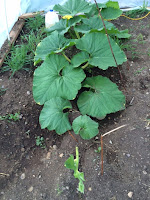 The 282 plant is looking better all of the time. Growth on the main vine for it might be a touch faster than the 1985 at the same stage. It still has some catching up to do, but I have more and more hope for this plant all the time.

The 1985 looks very 2009ish to me. The fact is that it should look that way, but from a genetic standpoint both plants are very similar. If you look at the shape of the leaves on both plants they almost look identical.
I can tell the RAW Nitrogen (learn more) I gave the plants kicked in. This type of nitrogen is one of the few non-organic fertilizers that I give plants but the quantities are small and this type of nitrogen is readily available to the plants. The leaves got bigger on both plants and the side vines have started growing a little faster.

Wednesday, June 3, 2015
Nitrogen Time for the Pumpkin Plants
I've been giving the plants small doses on nitrogen for the last couple of weeks. That was mostly because of the lack of sun and I was hoping that the nitrogen might make the plants a little happier. What I found is that it did little to nothing. Only the sun was going to fix the main problem.
Today I gave the plants a dose of RAW Nitrogen 20-0-0 (learn more) and RAW Omina 14-0-0 (learn more). These were applied as a drench but in fairly small quantities (about 1/16 tsp of each per plant). Right now that the plants are vining, they need a little extra nitrogen to push them along and give them the energy they need.
Both plants have been looking perfectly happy the last two days. Color is looking much better and growth is good.
Tuesday, June 2, 2015
Tilled the Cover Crop Today in the Pumpkin Patch

This is the best cover crop I've ever had. All of the warm weather in April and then a ton of rain in May really helped it grow. Now that it is tilled into the soil it will break down quickly. With warm temperatures, it will mostly be gone in two weeks, just in time for the vines growing all over the place.
Hot in Denver today. I think it hit around 93 degrees today. Went from what felt like winter two weeks ago to summer in almost no time at all. Too warm for plants in hoop houses, but they seemed to do pretty well in spite of the heat.
Monday, June 1, 2015
And Then there Were Two
I hated to do it, but it had to be done. I pulled the 1415 plant in favor of the 282 plant. The 1415 was getting very close to the end of the hoop house. Even had a flower on it open today. But since that main vine dented I couldn't go with it. The 282 plant is 5-6 days behind it and it hasn't ever had good color. It is growing well however, so I hope that once it gets wired up that it will turn into a better looking plant. I hate playing catchup however.
Looking at pictures from my 1421 plant from 2013 on this same date, I'm doing okay. The 282 is maybe a foot shorter than it on this same date.
The 1985 plant so far looks like a champ. Not overly aggressive, but not a slow grower either. Still growing 6+ inches a day right now so it is on target. It will probably be out of the hoop house by the end of this week at its current growth rate. I'm liking having these bigger hoop houses this year.
 |
| 1985 Miller |
 |
| 282 Scherber |
Sunday, May 31, 2015
Plants are looking Much Better
What a difference some sun and warmth makes. Color looks much better for all plants. Yesterday I did an application of multi-mineral and today I did a drench of cal/mag, yucca and B-vitamins at a very low dose.
I'm hating myself for letting the main vine on the 1415 plant getting bent. It has turned into a real nice plant that is growing quickly. 282 plant is 5 days behind it but is looking similar. Main vine is on the ground and running now.
It is going to be high 80s in Denver for the next 4 days. Too warm for hoop houses. I have my hail netting draped over the hoop houses to help keep them a little cooler.
Saturday, May 30, 2015
How to Diagnose Pumpkin Plant Problems
Are your pumpkin leaves turning yellow, brown or do you have spots on your leaves? Is the plant wilting or have bumpy leaves or some other kind of issue? Check with the doc! The MadMan put together this great guide to help all kinds of pumpkin plant problems.
View Pumpkin Plant Problem Guide
View Pumpkin Plant Problem Guide
Friday, May 29, 2015
How to use EC Testing of Soil for Proper Fertilizing

When I heard about what world record grower holder Beni Meir was doing with EC testing was it perked up my ears. Basically Beni used an EC testing device that tests the salts in his soil to figure out when to fertilize. Basically nitrogen, phosphorous and potassium are salts and the electrical conductivity tester gives a reading of how much salts are in a solution. An EC tester won't tell you what nutrient a plant needs or what nutrient is deficient, but when testing during the season you can see the EC numbers drop as the season goes on and when the numbers go down you can then hit the soil with some fertilizer to get the numbers back to optimum levels.
During the season I'll give some updates on this and what I find. I did an interesting test today where I tested the soil inside of both hoop houses and outside of both hoop houses and it was clear that with all of the rain we've had there has been some leaching.

Wednesday, May 27, 2015
Kids Plants Are Finally in their Hoop Houses
 |
| 282 Scherber (daughter's) |
My son is growing a 1689 Daletas. It is a nice cross of two different 1495 Stelts seeds. I like the 1495 genetics. They tend to grow really big pumpkins that go very heavy and often times they are very orange. The leaves on this plant are very dark green.
 |
| 1689 Daletas |
Tuesday, May 26, 2015
Bury Your Pumpkin Vines & Oops
If you bury your pumpkin vines a root will grow out of the top and bottom of the vine at each leaf node. You can easily add hundreds of pounds to your pumpkins by covering the vines with dirt. It will also help the plan in the wind and help protect the vines on hot days.
Today I was burying the vines on my 1985 and 1415 plants. Found something bad on the 1415 plant however. The main vine is kinked a little. I worried about that in the cool weather we had last week. The vine was dangling in the air because it hadn't laid down yet. I had put a bamboo shoot under it to support it some, but what I did wasn't enough.
I'm probably going to have to go with the 282 plant now. The pipes will be kinked in that 1415 plant which will probably restrict the flow of nutrients in the plant and I don't want that. The 1415 plant is about 5-7 days ahead of the 282 because it was germinated a week earlier and it has slightly better color. I was planning on pulling the 282 this week, but this is why you grow a backup in the same hoop house.
Monday, May 25, 2015
Vines are Down, Time for the Plant to Grow
I went out of town on Friday and got back today. Plants are looking better, but a bit off color still. A little sun today and a few days of sunny weather to come should help with that. Both the 1415 and the 1985 plants have their vines on the ground now and are just over 3 feet long now. At this point I would have liked to see the vines about a foot longer, but a month of no sun and cool weather has slowed things down. Today I gave the plants a little foliar fish to help push it a long a little. Also did a drench of Biotamax, Actinovate with iron and Myco Grow. Next week we will add some nitrogen to the mix to start pushing those vines along.
It has been interesting to watch the plants in the yard. At the end of April we were about 2 week ahead of schedule in plant growth. We are now about 3-5 days behind because of the weather in May. I'm guessing that when thing warm up everything is going to explode.
Pictured below are the plants.
It has been interesting to watch the plants in the yard. At the end of April we were about 2 week ahead of schedule in plant growth. We are now about 3-5 days behind because of the weather in May. I'm guessing that when thing warm up everything is going to explode.
Pictured below are the plants.
 |
| 1985 Miller |
 |
| 1415 Scherber |
Subscribe to:
Posts (Atom)