
Learn How to Grow a Giant Pumpkin. Competition Giant Pumpkin Seeds, Fertilizers & Growing Tips from Jamie 'The Pumpkin Man'. The Most Read Extreme Gardening, Pumpkin Blog in the World.
Monday, May 23, 2011
A Big Thanks to CBS Trucking & Excavating!


Saturday, May 21, 2011
Actinovate, Compost Tea and a Touch of Fish & Seaweed for the Pumpkin Plants
Thursday, May 19, 2011
The Unsatisfied Pumpkin Grower
Three weeks ago I was complaining because the patch was too dry. Two weeks ago I was complaining because it was too cold. One week ago I was complaining because it was too wet. Today I’m complaining because of too much hail.
Some growers just can’t be happy.
Wishing for some warmer days so I can get the main going a little more. Hard to get the hoop house to 80 degrees for more than a couple of hours these last two weeks. The rain is good for the patch but this much is overkill. Some low 80s so I can get the hoop houses to about 90 degrees would get those mains growing a little faster so I can get them on the ground and get them running.
Wednesday, May 18, 2011
Some Pics from the Pumpkin Patch
 866 Johnson (1161 Rodonis x 1544 Revier)
 1306 Mohr (1161 Rodonis x 1288 Wallace)
 1204 Scherber (1421 Stelts x 1725 Harp)
Sunday, May 15, 2011
5 Most Common Questions About Growing Giant Pumpkins
1. do you use special seeds?
Yes! Atlantic Giant seeds are the only variety of pumpkin seed that will get over 500 pounds and the Atlantic Giant seeds you get in the hardware store probably aren't going to do it for you. You need seeds that have had controlled crosses of the best seed stock to get the real giants. With them to grow a pumpkin over 100 pounds is not very difficult. If you haven't already started some seeds now is a perfect time! Get seeds from the Pumpkin Man at http://seeds.denverpumpkins.com.
2. What do you feed a giant pumpkin?
A well composted soil that is balanced is key to growing a giant pumpkin. Most of what will determine if you are going to grow a giant pumpkin happens before you even put the plant in the ground. A great soil comes through some hard work and soil tests to make sure the levels of nitrogen, potassium, potash and calcium are in the right ratios.
3. What do you do with the pumpkin at the end of the season?
I'll usually put it on display in the driveway until Halloween. It is real hoot to see people's reactions when they drive by.
4. How much time does it take to grow a giant pumpkin?
Most competitive giant pumpkin growers will spend about an hour a day on a plant. Wives/husbands of pumpkin growers are referred to as pumpkin widows during the growing season.
5. What is the secret to growing a giant pumpkin?
The real secret is that there are about 1,000 little secrets. Giant pumpkin growing is wonderfully complicated. Soil sciences, genetics, plant biology, chemistry and more go into growing a state or world record. Rarely does a giant happen by accident. The good news is that most growers will tell you anything that you want to know about growing a big pumpkin if you ask. As a matter-o-fact you probably won't be able to get them to shut up once you get them started. Lol
Got a question for The Pumpkin Man? Leave a comment by clicking the Comment link below.
Friday, May 13, 2011
A Little Test with Biotamax
 Last year I tried a new product called Biotamax. Yesterday I decided to do a little test with it on the lawn. Biotamax comes in a tablet form that is full of benefical fungi and bacteria know as soil probiotics. The trichoderma in biotamax can help control plant pathogens in the soil. Esentially they eat the bad stuff and help the plant grow.
Wednesday, May 11, 2011
Pumpkin Plants in the Ground and Snow on the Hoop Houses
In the second hoop house I've put the 1308 Todd (50 Todd x 901 Hunt). This was a plant that I was seriously considering planting at the beginning of the season. The plant that Barry gave me is a very nice looking one with a very thick stump on it. This plant is very intriguing because Barry didn't start the seed that grew the 1308 until the end of the first week of May because he wasn't even planning on growing last year. He still had a pollination about the same time as the other main growers in Colorado and the pumpkin grew right until picking the 2nd week of May. The 901 Hunt that was crossed into that pumpkin went 26% heavy last year and thumped like cement. I'm hoping the aggressiveness of the 50 Todd with the heavy of the 901 will produce a pumpkin that will fix some of the problems I had last year.
In with the 1308 Todd is the 1204 Scherber (1421 Stelts x 1725 Harp). My good 1204 was frost bitten unfortunatley and this plant was slow from the start but it started to take off this last week so I have hopes for it. It had a very nice root system on it when I pulled it out of the pot. I love this cross and would love to put Joe's 1725 clone into it.
In about two weeks I'm going to have to decide which plants to go with. I'll look at the color, growth, and overall health of the plants when I make my decisions.
With the cold weather and snow today in Denver I've got the space heather going in one hoop house and in the other hoop house I have the heat lamp and a 75 watt bulb. All of the plants looked really happy this morning which was good.
Sunday, May 8, 2011
A Shout Out to the Rocky Mountain Giant Vegetable Growers
Giant pumpkin growing is an interesting hobby because, although it is competitive, growers really help each other. You can pretty much ask any grower in Colorado how they grow and they would pretty much tell you everything that they know. Growers realized early on in this sport that you can't learn everything these is to know about pumpkin growing in three lifetimes on your own. Only by sharing and helping each other can you learn the techniques to grow a giant.
Late last fall I and my wife were invited to be on NBC's The Marriage Ref (show to air this Summer). I needed a giant pumpkin for the show and the growers really stepped it up for me, particularly Gary the club president. No questions asked, people wanted to help.
I think it has been three years in a row now that one of the Colorado giant pumpkin weigh-offs has taken 2nd place for most improve site in the world. That is a real testament to quality of the growers here.
I am grateful for the great Colorado pumpkin growers.
Friday, May 6, 2011
Rough Start To the Pumpkin Season
 There actually hasn't been that much wind today and the weather is quite nice. Guess there must have been one big gust.
 Thursday, May 5, 2011
A Little to Cold for the Pumpkin Plants
 Had something happen last night that hasn't happened before. The 1204 hoop house got a little froze. Not sure why. The hoop house has a 250 watt heat lamp bulb in it but the leaves were pretty beaten up this morning after a 29 degree night. The night before it got down to about 31 degrees but the plants came out fine.
 The other hoop house has a thermostatically controlled space heater in it and those plants looked fine this morning. My guessing is that the 1204 plants will snap out of it but will be slowed up for a day or three as they get back into shape. Kind of disappointing however. In the past I've usually just had a standard 75 watt bulb in the hoop house and never had any issues like this.
Tuesday, May 3, 2011
Hoop Houses are Built and Pumpkin Plants are in the Ground
This evening I put the plants in the ground. I've had clear plastic over the planting area so to help warm up the soil and it seemed to work fairly well. The soil was relatively warm a foot down which will help the roots want to grow and help minimize shock to the newly transplanted plants.
In each planting hole I put a touch of Azos, some myco, humic acid and a touch of earthworm castings. I loved the smell of the soil. Sweet and healthy.
After planting the plants with the first true leaf in the opposite direction of where I wanted the main vine to run I gave each plant a deep drink with a small touch of liquid seaweed in the lightly warmed water.
I pot two plants in each hoop house and when the plants have grown to the point that the leaves are touching I'll take out the weaker plant and then we hope and pray that we chose the right plant.
At this time of year the plants can be deceptive. A vigorous growing plant doesn't necessarily indicate that it will grow the biggest plants. Some plants genetically just want to grow salad which doesn't do a competitive giant pumpkin grower much good.
I usually look at the leaf color, leaf health, stump area and then throw some dice to decide which plant to go with. There is some science but it is mostly just a got feeling with a touch of experience.
In one hoop house I have a heat lamp and in the other hoop house I have thermostatically controlled space heather. These will keep the plants warm on cold nights. The next few days the evening lows look pretty kind for this time of year.
Tomorrow morning we will see which plants look happy.
Wednesday, April 27, 2011
The Pumpkin Plants are Growing Nicely
 Today I took the pumpkin plants out for their first direct sun of the season. It was the first day in a while that it hasn't been too windy or too cold or that we even had some consistent sun. The plants seemed to like it. In past years the leaves tended to droop after a little while when the plants got their first direct sun light because they weren't used to the intensity. This year I added some additional wattage to the grow "closet" and that seems to have helped. (note to DEA: the glow from the closet is not illicit. Please don't kick the door down.)
Sunday, April 24, 2011
Order Giant Pumpkin Seeds from The Pumpkin Man!
Would you like to take a shot at having the biggest jack-o-lantern on your street or maybe a world record pumpkin? I've got some of the best genetic seeds in the world for you. Order now to grow a giant! It is a great activity to do with your children or to show the neighbors who is the best gardener in the neighborhood. Each seed are the same type of seeds that competitive giant pumpkin growers use and have world record genetics. Shop giant pumpkin seeds

Tuesday, April 19, 2011
It's Grow Time
 Every seed germinated and it is pumpkin plant growing time. My experience is that for the first few days after the plant pops out of the seed starting mix the plants grow really fast and then they slow down for a bit and then take off again later. The seeds that I've planted are two 1204 Scherbers, two 1306 Mohrs, a 868 Johnson and a 1325 Sperry. My kids will probably grow one of the later two plants. They did a great job of choosing their seeds, preparing the seed starting mix, filing their seeds and soaking them. They decided not to use the paper towel method to get their seeds started but I suspect the seed will be popping out the soil any day now.
Saturday, April 16, 2011
Some Aggressive Pumpkin Plants
Thursday, April 14, 2011
Giant Pumpkin Seed Starting. Let the Season Begin!
 Tonight I sanded the edges of my pumpkin seeds and I am soaking them now in warm water with a drop of seaweed and a little humic acid to help them germinate. After an three hours of soaking I will transfer the seeds to lightly moistened paper towels that will be folded around the seeds and put into Ziploc bags. The Ziploc bags will then be placed at the back part of my computer where it is usually about 85 degrees. An ideal temperature for pumpkin seed starting is between 85 to 90 degrees. In 24 to 48 hours a little root will come out of the bottom of the seed and at that time I will transfer the seeds to my seed starting mixture in peat pots.
For my seed starting mixture I use 80% ProMix BX, about 20% earthworm castings, some myco, and this year I'm going to add a little BiotaMax to the pots. BiotaMax is a combination of friendly bacteria and fungus that will help protect and feed the pumpkin plants. About 48 hours after putting the seeds in the pots they will start popping through the soil. I have the pots in a closet with grow lights and a space heater so I can keep the plants at about 85 degrees. About two weeks later I'll be taking the plants outdoors.
The seeds I am growing this year are the 1204 Scherber (1421 Stelts x 1725 Harp) and the 1306 Mohr (1161 Rodonis x 1288 Wallace). The weight of the pumpkin that the seed came from is the number and the name following is the last name of the grower that grew the pumpkin. The numbers in brakets after it are the female and male pollinator for the seed. Both of these seeds came from Colorado growers. The 1725 Harp pollinator for the 1204 Scherber is a seed from the former world record pumpkin. The 1161 Rodonis in the 1306 Mohr is a seed from the same pumpkin that grew the world record 1,810 pound pumpkin so there are some great genetics in these seeds.
We are off to the races! Hopefully we will be reporting giant pumpkins from these seeds come September.
Sunday, April 10, 2011
Pumpkin Season is Springing Upon Us
Biota Max's has developed a new tablet form of the biologicals I used last year. In 2010 I used the liquid form and it appears that the tablet will be easier to use and it has more varieties of beneficial bacteria which will be great. The idea behind using beneficial bacteria and fungi are three fold:
- Overwhelm the soil with the good stuff so the there is no room in the soil for the bad bacteria and fungus
- Build synergistic relationships between the plant and the soil where the bacteria are fixing nitrogen in the soil and bringing nutrients beyond the reach of the pumpkin plant's roots back to the plant
- Add beneficial bacteria and fungus to the soil that will break down nutrients to a form that the pumpkin plant can use.
- These three things together are often referred to as the soil food web. A healthy soil is balanced, full of beneficial organisms and feeding the pumpkin to help it grow
This week I will be starting my pumpkin seeds for the season. In keeping with the normal pumpkin growers mentality of "more is better" I've added an additional 80watts of grow lights to my seed starting area.
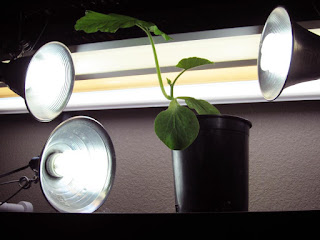 Today I brought my seed starting mixture (Promix BX), earthworm castings from my worm bins and a little humic acid into the house to begin warming them up so they will be ready for planting time. I'll start my seeds in paper towels and once the tap root comes out I'll put the seed into the soil mixture which will probably be on Saturday. A few days later I should have sprouts coming up and we are off to the races again with great hopes for September and October of this year.
Sunday, March 27, 2011
Doing the Final Spring Soil Pumpkin Patch Prep
Wednesday, March 2, 2011
Pumpkin Patch Soil Testing
To have great soil to grow a giant pumpkin you need to know what is in your soil. A soil test from a trusted lab is the only way to go. Putting on fertilizer and compost without knowing what is in the soil is like shooting in the dark. I am sometimes suprised with the results that I get back in the soil tests because there can be a lot of things that can make NPK to high or to low and without a balanced soil it can be hard to grow a big pumpkin.
I learned from Thad Starr that you have to be kind of careful in how you collect your sample. Take soil samples from multiple spots and use a clean spoon without any rust on it or your test results can be thrown off. A drop of sweat on the soil can change what should have been a normal sodium level in the soil to high sodium levels so you have to be careful what you soil comes in contact with. Take samples from about 6-8 inches down where your roots are going to be so that you know what is going to be available to your pumpkin plant.
Most labs can help you interpet what your soil needs but most labs don't know a lot about giant pumpkins need so ask a grower or post your results on bigpumpkins.com to get advice from other experienced growers.
I like where my soil is at right now. It has a sweet smell and you can see the last remanants of the shredded leaves that I put into the soil last fall. Depending on what my soil test shows I plan on adding three yards of well composted cow manure, humic acid and alfalfa in the next 6 weeks.
Monday, February 28, 2011
It's Been Too Long
I got some pumpkin seeds from Pete Mohr today that I plan on growing this next season. Pete's 1306 seed (1161 Rodonis x 1288 Wallace) I think has a lot of potential. The 1161 is a long grower with an extensive root system and those are traits I want to breed into my pumpkins. The 1288 tends to go heavy and that is another trait I want to breed into my plants. The other seed I will be growing in 2011 will be the 1204 Scherber (1421 Stelts x 1725 Harp). Joe's 1421 was a beast of a plant last year. Probably the best looking plant I've ever seen in Colorado. Even after the pumpkin the vines were 2 inches thick. The 1421 and the 1725 tend to be long growers and the 1725 has tended to go heavy so I'm thinking this could be a great cross too. Neither seed is proven but with the genetics in these plants I expect good things this next season.
I plan on getting some compost and tilling it into the patch the end of March if the weather will allow. I'm also going to try something new, adding some turbinado sugar to the soil as I do so. Turbinado sugar is a less processed cane sugar that still has some of the molasses in it. The idea behind it is to get more microbial activity in the soil by adding it to the soil. Soil microbes need carbon to live and sugar is an excellent source of carbon. In theory, adding the sugar to the soil should increase microbial activity and get the soil going good in the spring.
I haven't heard back from The Marriage Ref yet as to when our show will air. I'll let everyone know when I know more.