This evening I sprayed on the ground a liquid iron/sulfur fertilizer. It also had micro amounts of zinc, copper and other nutrients. Iron is a very import nutrient for plants. It is in the process of making chlorophyll. It is also involved in making of most of a plants enzymes. A plant doesn't need a lot of iron to grow healthy, but too little will cause chlorosis which shows up as yellow leaves.
The elemental sulfur will help drop soil pH. My pH is too high, like most western soils. As bacteria in the soil break down the sulfur an acid is produced, which helps drop the soil pH and more nutrients can become available to the plant.

Learn How to Grow a Giant Pumpkin. Competition Giant Pumpkin Seeds, Fertilizers & Growing Tips from Jamie 'The Pumpkin Man'. The Most Read Extreme Gardening, Pumpkin Blog in the World.
Tuesday, August 8, 2017


Sunday, August 6, 2017
Compost Tea for Giant Pumpkin Plants
I've haven't used as much compost tea on the pumpkin plants as I would typically do this year. Yesterday I started a brew that I applied this evening. It had compost, alfalfa, Actinovate, humic acid, silica, cane molasses, milk, NPK Bloom and a touch of kelp in it. After aerating it for 24 hours I spread it across the leaves of the plants and in the stump area. That should help fight off the powdery mildew and build the biology that will feed the plants.
Saturday, August 5, 2017
Feeding the Soil & Keeping the Microbes Going

The problem becomes that later in the season, when the pumpkin is putting on pounds, the plant can start to get stingy giving back the sugars to the microbes. As a result, some of the microbes may die off or become less productive. This is because the plant has most of what it needs and wants to feed the pumpkin. In order to keep those microbes growing and working for the plant, a good strategy is to put down some cane molasses on the soil. RAW Cane Molasses will feed the microbes and help build beneficial bacteria in the soil. It is also very easy to use and mix.
Today I put down NPK Microbes Bloom & Grow formulas with a some Azos and RAW Cane Molasses. I sprayed it under the canopy onto the soil and then took a watering pail and poured some around the stump areas of the plants. After that I watered it all in by running the sprinklers for 10 minutes.
Friday, August 4, 2017
Pics from of the Pumpkin Patches
This first pic is a picture of the "bird bath" that the 1685 "Cujoe" pumpkin has. One small spot was looking a little suspect for rot so I wiped the whole birdbath area with a 50% solution of bleach, then I put sulfur powder in it. That should take care of it. I also have a tarp to cover that pumpkin now so it won't fill full of water each watering.


Thursday, August 3, 2017
It's Good to Have Good Neighbors
A couple of days ago I noticed that on the 747 pumpkin I was having problems where the pumpkin was pressing up against the main vine and pushing it out. Poor vine maintenance. I didn't do a good job in putting an S curve in the vine and as a result the pumpkin had grown into the vine. With time it could have snapped the stem off the vine.
Thanks to a good neighbor who helped me pull the pumpkin back. Tried to do it myself but it wouldn't budge. Could just verily move it with the two of us. We should be in good shape now however. Were able, with a number of tries, to get it moved back and inch.
Thanks to a good neighbor who helped me pull the pumpkin back. Tried to do it myself but it wouldn't budge. Could just verily move it with the two of us. We should be in good shape now however. Were able, with a number of tries, to get it moved back and inch.
Wednesday, August 2, 2017
Battling Powdery Mildew in the Pumpkin Patch
I mentioned in a recent post that I've got some powdery mildew going on in the pumpkin patch. After returning from vacation I noticed it and now that I've had some time to get into the patch more, it is relatively bad for this early in the season.
The interesting thing is that the 747 plant has it bad. The 1685 plants show none. I've seen this before. Some plants seem more resistant than others to powdery mildew. The other thing is that the 747 plant got much more beat up by winds than the 1685 plants and that damage makes it more susceptible. All of the older leaves that survived the wind were covered in powdery mildew so I took them out of the patch to help keep it from spreading. The leaves that are a little younger but damaged are also showing relatively bad powdery mildew and I'll have to take those leaves out in the next couple of weeks. Getting the powdery mildew this early and this bad is bad sign. I'll have to manage it carefully or I'll have real problems in a month.
Today I hit all of the plants with a fungicide and a insecticide/fungicide.
Last night I put down some organic granular fertilizer (8-2-1). It is a slower release fertilizer. I also sprayed on the soil some potassium, humic acid, b-vitamins and Omina. The grandular doesn't have enough potassium and the pumpkins are feeding heavily on potassium at this point of the season so I want to keep the supply up. May have overdone it some on the nitrogen this week, so I'll back off on it the next couple of weeks.
The interesting thing is that the 747 plant has it bad. The 1685 plants show none. I've seen this before. Some plants seem more resistant than others to powdery mildew. The other thing is that the 747 plant got much more beat up by winds than the 1685 plants and that damage makes it more susceptible. All of the older leaves that survived the wind were covered in powdery mildew so I took them out of the patch to help keep it from spreading. The leaves that are a little younger but damaged are also showing relatively bad powdery mildew and I'll have to take those leaves out in the next couple of weeks. Getting the powdery mildew this early and this bad is bad sign. I'll have to manage it carefully or I'll have real problems in a month.
Today I hit all of the plants with a fungicide and a insecticide/fungicide.
Last night I put down some organic granular fertilizer (8-2-1). It is a slower release fertilizer. I also sprayed on the soil some potassium, humic acid, b-vitamins and Omina. The grandular doesn't have enough potassium and the pumpkins are feeding heavily on potassium at this point of the season so I want to keep the supply up. May have overdone it some on the nitrogen this week, so I'll back off on it the next couple of weeks.
Saturday, July 29, 2017
Pumpkin Pics & About 2 Weeks Too Late To Control Powdery Mildew
Typically around the end of July I start spraying Actinovate on the pumpkin leaves to help control powdery mildew before it happens. This year I was out of town the last week and found that the 747 plant has spots on them. Actinovate works well to help powedery mildew from coming on if applied before it starts, but don't do anything to get rid of it. So I am about two weeks two late.
Nonetheless, I sprayed all of the plants with Actinovate today to help it from coming on and slow down what I have. Actinovate is interesting because it is a natural way to control powdery mildew and other diseases naturally. It is also the only thing of its kind that I know of that works on the leaves and the soil.
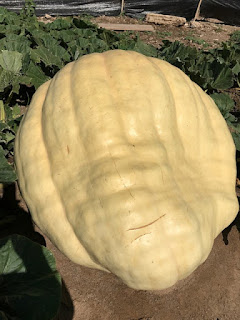
These are the latest pics from the patch. The 1685 is turning into a satellite dish (kind of a surprise) and the 747 keeps chugging along. The 1685 is doing about 18 pounds a day right now and the 747 is around 16 pounds a day.

Nonetheless, I sprayed all of the plants with Actinovate today to help it from coming on and slow down what I have. Actinovate is interesting because it is a natural way to control powdery mildew and other diseases naturally. It is also the only thing of its kind that I know of that works on the leaves and the soil.
These are the latest pics from the patch. The 1685 is turning into a satellite dish (kind of a surprise) and the 747 keeps chugging along. The 1685 is doing about 18 pounds a day right now and the 747 is around 16 pounds a day.


Friday, July 28, 2017
The Pumpkins After a Week
I've been up in Canada for the last week and a day and just returned tonight after dark. I can see the plants have put on some descent growth (particularly the 1685 Scherber) and the pumpkins obviously have continued to grow. The 1685 Scherber in particular has grown in size. Just a few days ago it hit 30 days after pollination, so right now it should be really taking off. I don't expect really big growth for the reasons I've cited in previous posts, but this pumpkin is obviously doing better than the pumpkin I took off the plant a couple of weeks ago so it will be interesting to see how it ends up. Right now it looks like it has the potential to catch the the 747 Johnson pumpkin (AKA Jumbo). I still need to come up with a name for this pumpkin. Maybe Cujoe?
This evening I did a foliar application of TKO, with some nitrogen, kelp and humic acid. Foliar applications if the fastest way to get nutrients into the plan and with no feeding for the last week plus, the plants are probably starting to get a little hungry.
This evening I did a foliar application of TKO, with some nitrogen, kelp and humic acid. Foliar applications if the fastest way to get nutrients into the plan and with no feeding for the last week plus, the plants are probably starting to get a little hungry.
Tuesday, July 18, 2017
Foliar Feeding Pumpkin Leaves with Seaweed & Humic Acid
I can't think of anything that could be better to foliar feed a pumpkin plant with than seaweed/kelp and humic acid. The two work synergisticly together to provide a lot of benefits to the plant. Improved laterally branching, cell elongation, leaves that stay healthier longer and improve fruit set are just some of the value that comes from seaweed. Those values are improved further when humic acid is applied with the seaweed/kelp.
This evening I did a foliar application of RAW Kelp along with RAW Humic Acid.
This evening I did a foliar application of RAW Kelp along with RAW Humic Acid.
Sunday, July 16, 2017
Some Fertilizer for the Pumpkin Plants
Because of that yellowing on the leaf edges, I decided to to a light foliar application of NPK Grow (7-3-4), multi-mineral, humic acid and fish. That is pretty broad spectrum in terms of nutrients so most everything should be covered.
Also, did a light application of TKO on the soil because there was a little left in the sprayer from the last application.
Also, did a light application of TKO on the soil because there was a little left in the sprayer from the last application.
Saturday, July 15, 2017
Need Some Help Diagnosing Yellow On Leaves
Any suggestions as to what might be causing this yellowing on the edges of newer leaves? Is it a deficiency or a toxicity? Click the image to see a larger view.


Confessions of a Competition Giant Pumpkin Grower
Okay, I have to admit it. I'm naturally a very competitive person. I love competition. Prettty much enjoy it when someone challenges me and I know I'm ready to meet the challenge or know I can step up to it. In high school I played tennis and at the beginning my senior year for a stretch I was playing poorly prior to the season. The assistant coach asked me what was going on and I told him I was playing great two weeks before, but lately I was struggling. The coach said, "Jamie, your just not that good." I didn't say anything, but I was mad. It was just what I needed. I hadn't been playing with confidence, but I threw that out the window because in my mind, nobody was going to say that to me because I KNEW that was wrong. That season in matches I didn't lose a single set until the state championship.
I use my competitive nature to help my pumpkin growing. On days like today I create little competitions in my mind go make sure I bury vines during hot days like today. I must have buried vines for three hours today. At points I wanted to stop or do a half way job. But then I would think of my competition and it helps me push through it.
I remember my first season I didn't really know what to expect. I set a goal of 500 pounds, but wasn't sure if that was possible. Early in the season there was a small hail storm and I lost the tip of the main vine. I posted some questions on the RMGVG discussion board and got some good advice back, but one grower who had grown for a few years, made some comments that were kind of insensitive. He became my motivation. Losing a vine tip sets you back about two weeks. I didn't know how my season would end pumpkin wise, I just knew I was going to beat that "jerk." I ended up beating him and having a pumpkin that was about 100 pounds bigger than any pumpkin he ever grew. I remember him making a comment about that at the weigh-off. It was sweet to me.
That same year, I got beat by a second year grower, by just two pounds, that is a really nice guy. I unconsciously decided I was going to beat him that next year. I worked hard in the patch until a massive hail storm COMPLETELY took out my plants. I got him the next year however. Lol
Is it childish? Maybe, but it works for me.
I've seen growers set state records because of another grower that they were openingly having arguments with and they were going to do everything in their power to beat that other guy.
If you are a grower that gives it everything you got simply because you love watching the plant grow to its potential then go with that. I don't really care where you find your motivation, but be motivated. If it is worth doing it, then do it well and grow them big!
Where do you find your motivation?
I use my competitive nature to help my pumpkin growing. On days like today I create little competitions in my mind go make sure I bury vines during hot days like today. I must have buried vines for three hours today. At points I wanted to stop or do a half way job. But then I would think of my competition and it helps me push through it.
I remember my first season I didn't really know what to expect. I set a goal of 500 pounds, but wasn't sure if that was possible. Early in the season there was a small hail storm and I lost the tip of the main vine. I posted some questions on the RMGVG discussion board and got some good advice back, but one grower who had grown for a few years, made some comments that were kind of insensitive. He became my motivation. Losing a vine tip sets you back about two weeks. I didn't know how my season would end pumpkin wise, I just knew I was going to beat that "jerk." I ended up beating him and having a pumpkin that was about 100 pounds bigger than any pumpkin he ever grew. I remember him making a comment about that at the weigh-off. It was sweet to me.
That same year, I got beat by a second year grower, by just two pounds, that is a really nice guy. I unconsciously decided I was going to beat him that next year. I worked hard in the patch until a massive hail storm COMPLETELY took out my plants. I got him the next year however. Lol
Is it childish? Maybe, but it works for me.
I've seen growers set state records because of another grower that they were openingly having arguments with and they were going to do everything in their power to beat that other guy.
If you are a grower that gives it everything you got simply because you love watching the plant grow to its potential then go with that. I don't really care where you find your motivation, but be motivated. If it is worth doing it, then do it well and grow them big!
Where do you find your motivation?
Friday, July 14, 2017
TKO the Pumpkin
This evening I did a soil application of TKO Phosphite 0-29-26 with a little nitrate nitrogen. Betsy of the RMGVG gave me the TKO a few years ago, but I've not had much of a chance to use it because of the move and problems in the patch the years previous. TKO is high phosphite and potassium. It is easily absorb-able into the plants, strengthens cell walls, increases systemic response and has anti-fungal properties.
I can't figure out if TKO is a good source of phosphorous however. I read different opinions on that. From what I can figure out, phosphites are somewhat different than phosphorous so that is why it has some of its unique attributes, but it doesn't completely replace phosphorous. It sounds like phosphites might be a great way to help a plant that is phosphorous deficient however because it can be absorbed quickly because it doesn't get bound up in the soil like phosphorous does.
I purposefully made sure the TKO was only put on the soil, because I did a foliar application of multi-mineral earlier in the week and the copper in multi-mineral and TKO don't mix nicely.
I can't figure out if TKO is a good source of phosphorous however. I read different opinions on that. From what I can figure out, phosphites are somewhat different than phosphorous so that is why it has some of its unique attributes, but it doesn't completely replace phosphorous. It sounds like phosphites might be a great way to help a plant that is phosphorous deficient however because it can be absorbed quickly because it doesn't get bound up in the soil like phosphorous does.
I purposefully made sure the TKO was only put on the soil, because I did a foliar application of multi-mineral earlier in the week and the copper in multi-mineral and TKO don't mix nicely.
Latest Pics from the Pumpkin Patch
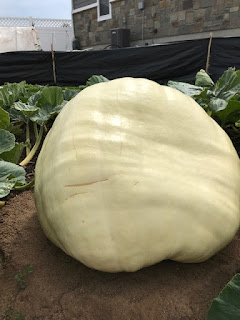
The following are pictures from this morning from the pumpkin patch. I've always considered, what I call the Wallace hump an interesting genetic phenomenon. If you look at pictures of Ron Wallace's record breaking 2009 pumpkin from the front, you'll notice that the pumpkin isn't symmetrical. There is one side that has more mass.
My 747 plant has the same trait and I've seen this in many of the pumpkins that came out of the 2009 seed. At first I wouldn't have called a genetic trait, but probably an environmental factor, but since it seems to show up again and again it must be genetic. The 747 seed has probably more of the 1725 genetics that grew the 2009 than any other seed out there, so you would expect this trait to show up. The 747 seed is a selfed clone of the 1725 that grew the 2009 wallace crossed with the 1985 Miller (2009 x 1725). At least 62% of the genetics are from that 1725 world record plant.
 I'm a bit worried about the kids plants. Growth seems slow and the vine tips are looking funny these days. I'm hoping they don't have yellow vine disease. Will continue to watch that.
My 747 plant has the same trait and I've seen this in many of the pumpkins that came out of the 2009 seed. At first I wouldn't have called a genetic trait, but probably an environmental factor, but since it seems to show up again and again it must be genetic. The 747 seed has probably more of the 1725 genetics that grew the 2009 than any other seed out there, so you would expect this trait to show up. The 747 seed is a selfed clone of the 1725 that grew the 2009 wallace crossed with the 1985 Miller (2009 x 1725). At least 62% of the genetics are from that 1725 world record plant.


Saturday, July 8, 2017
Looking Back in Time
Lamenting the growth rate of the pumpkins this year, I went back to my growth chart in 2013 to the year I had my biggest pumpkin ever for comparison. It made me a bit depressed. That 1421 pumpkin named Stanley was 400lbs already when it was only 30 days old. Those were good times.
I've been reading some on what I can do to help the night time temperatures in a high tunnel when I add it. The high tunnel should take care of the wind problems, but the overnight lows are still an issue. Obviously a big propane heater would help, but would be costly. I already have 55 gallon barrels to put in the hoop house. I also have the geothermal setup, but I would guess that those will only raise the temperature 5-7 degrees at the most, and I really need something more like 15 degrees to really make a noticable difference and 20 degrees to grow a world class pumpkin. That is a lot. If anyone has any good ideas, please let me know.
This evening I did a foliar application of NPK Grow (7-3-4) on all of the plants.
I've been reading some on what I can do to help the night time temperatures in a high tunnel when I add it. The high tunnel should take care of the wind problems, but the overnight lows are still an issue. Obviously a big propane heater would help, but would be costly. I already have 55 gallon barrels to put in the hoop house. I also have the geothermal setup, but I would guess that those will only raise the temperature 5-7 degrees at the most, and I really need something more like 15 degrees to really make a noticable difference and 20 degrees to grow a world class pumpkin. That is a lot. If anyone has any good ideas, please let me know.
This evening I did a foliar application of NPK Grow (7-3-4) on all of the plants.
Choosing Which Pumpkin to be the Chosen One
Typically I've usually gone with my earliest pollination on the main vine, but the 1685 plant's first female showed up at 8 feet, which is earlier than I would prefer to grow a pumpkin (10+ feet is ideal with the sweet spot between 12-14 feet). The next female on the main vine didn't show up for another 2 1/2 weeks, but since the first pollination was very early and the plant was relatively small, I had some decisions to make.
Intuition would tell you that pollinating early is your best bet to growing the biggest pumpkin. There is truth to that, but it isn't fully true. The first 2 1/2 weeks of pumpkin growth and the last 2 1/2 weeks count very little because you are talking 1-7 pounds a day typically at those times of the year. Maybe 7-9% of the pumpkin's overall weight at the end of the season. Every pound counts, but overall it doesn't a make or break the overall weight. Because a pumpkin typically doesn't grow more than 100 days, if you can pollinate a couple of pumpkins early enough and you are still under or close to 100 days from the weight-off then you can make some decisions on which pumpkin to grow.
 Positioning on the vine and growth rates are the two main things I look at when deciding which pumpkin to grow. When it comes to growth rate, the later pollination will always be a little slower because the first pumpkin will be taking a bigger portion of the plant energy, so you have to put that into your calculations. If you choose to take off the first pollination I'd suggest cutting the stem half way the first day and then the rest of the way the next day so a serge of energy doesn't hit the 2nd pumpkin. Told that can cause problems, but I've never seen it.
Pictured here is the pumpkin on the 1685 Scherber that I cut off this morning. It was a slow grower from the start. After cutting it off and weighing it I found that it also went 12% light (a double whammy). I figured I don't have much to lose by taking this pumpkin off and seeing how the other pumpkin performs. Kind of a risk, but there is no risk of this pumpkin becoming a giant, so I'll do comparison measurements between the two pumpkins on the same number of days and see how this decision turns out. The later pollination will be 97 days old by the time I pick it so, it should have a full grow as long as we don't get an early frost (which is a real possibility in Midway).
The 747 pumpkin (AKA Jumbo), is growing about 30% faster than the 1685 pumpkin was growing, but still well under what I would like it to be. Nighttime lows right now are very acceptable for growing, but the day time highs have been in the 95-100 degree range, so I just cant win. I mist the plants regularly during the day, but you can only do so much to beat the heat.
Intuition would tell you that pollinating early is your best bet to growing the biggest pumpkin. There is truth to that, but it isn't fully true. The first 2 1/2 weeks of pumpkin growth and the last 2 1/2 weeks count very little because you are talking 1-7 pounds a day typically at those times of the year. Maybe 7-9% of the pumpkin's overall weight at the end of the season. Every pound counts, but overall it doesn't a make or break the overall weight. Because a pumpkin typically doesn't grow more than 100 days, if you can pollinate a couple of pumpkins early enough and you are still under or close to 100 days from the weight-off then you can make some decisions on which pumpkin to grow.

Pictured here is the pumpkin on the 1685 Scherber that I cut off this morning. It was a slow grower from the start. After cutting it off and weighing it I found that it also went 12% light (a double whammy). I figured I don't have much to lose by taking this pumpkin off and seeing how the other pumpkin performs. Kind of a risk, but there is no risk of this pumpkin becoming a giant, so I'll do comparison measurements between the two pumpkins on the same number of days and see how this decision turns out. The later pollination will be 97 days old by the time I pick it so, it should have a full grow as long as we don't get an early frost (which is a real possibility in Midway).
The 747 pumpkin (AKA Jumbo), is growing about 30% faster than the 1685 pumpkin was growing, but still well under what I would like it to be. Nighttime lows right now are very acceptable for growing, but the day time highs have been in the 95-100 degree range, so I just cant win. I mist the plants regularly during the day, but you can only do so much to beat the heat.
Thursday, July 6, 2017
Hot in the Pumpkin Patch Today
Hit 101 degrees today and it has stayed warmer longer than it normally does in Midway, UT. By this time it typically starts cooling off, but not much cooling so far this evening.
Gave the plants a lot of extra water today and ran the sprinklers once every hour to help keep the plants cool. Leaves after the pumpkins were folded like flags, as the pumpkins have started to kick into gear and are starting to pull most of the plants energy.
Put down some granular, organic 8-2-1 around the outer edges of the pumpkin plant this evening. After talking with Joe Scherber last week when I visited his patch, I decided I've been under fertilizing the pumpkin plants in the past, so the frequency that I fertilize will probably double. Since I put down a fair amount of fertilizer on the 4th, I just put this fertilizer mostly at the edges of the vines. Those areas haven't been fertilized much, so I want to make sure the nutrients are there once the roots get out to those outer areas.
Gave the plants a lot of extra water today and ran the sprinklers once every hour to help keep the plants cool. Leaves after the pumpkins were folded like flags, as the pumpkins have started to kick into gear and are starting to pull most of the plants energy.
Put down some granular, organic 8-2-1 around the outer edges of the pumpkin plant this evening. After talking with Joe Scherber last week when I visited his patch, I decided I've been under fertilizing the pumpkin plants in the past, so the frequency that I fertilize will probably double. Since I put down a fair amount of fertilizer on the 4th, I just put this fertilizer mostly at the edges of the vines. Those areas haven't been fertilized much, so I want to make sure the nutrients are there once the roots get out to those outer areas.
Wednesday, July 5, 2017
Fertilizing the Pumpkin Plants
After being gone for 10 days, yesterday I gave the pumpkin plants a relatively heavy dose of potassium, fulvic acid, B Vitamins, Omina (a nitrogen source) and seaweed along with some beneficial microbes (NPK Bloom). I usually don't prefer to give a larger amount of fertilizers at once, but since I wasn't around to give smaller doses, I wanted to play a little catch up. The two early pollinations are at their rapid growth stage, so I want to make sure the nutrients they need are in place.
Today I did a foliar application of Metosolate Multi-mineral. It has all of the basic minerals in a chelated form, which allows it to be more easily absorbed into the leaf. I put in a little Cal Carb with it. The forecast is for 97 degrees over the next few days. It was supposed to get that warm today and it did, but it clouded up right after that and dropped down to about 90 degrees.
Today I did a foliar application of Metosolate Multi-mineral. It has all of the basic minerals in a chelated form, which allows it to be more easily absorbed into the leaf. I put in a little Cal Carb with it. The forecast is for 97 degrees over the next few days. It was supposed to get that warm today and it did, but it clouded up right after that and dropped down to about 90 degrees.
The Pumpkins
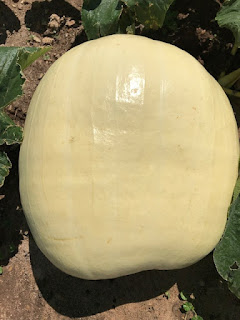
The following are pictures of the pumpkins. I've been out of town for the last 10 days so I've got a lot of vine burying to do. The whiter pumpkin is the pumpkin on the 747 Johnson plant. It is by far the faster growing pumpkin in the patch, but well behind the biggest pumpkin's of the past, growth curve wise. Damage from winds and cold nights have been a big challenge.
I like the smooth skin on this pumpkin. Shape and color are all from the 282 Scherber side. Almost everything about this plant has looked like the 1725 clone that is the grandparent. It makes me wonder what this plant could have done in better circumstances. Lot of growing left to go however. We are just getting into the fast growing phase, so it will be interesting to see if this plant can make up some for lost time with the warmer nights we are having right now. I'm going to call this pumpkin "Jumbo" since it is from the 747 seed.
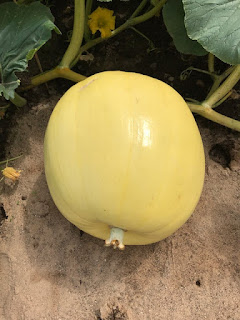
The yellow/orange pumpkin is the one on the 1685 Scherber plant. It is growing slow, but picking up some speed. I have another pollination that is 10 days old that I'll probably go with and will take this pumpkin off because the plant was small when it was pollinated and the position on the vine isn't great. 10 day measurements were considerably bigger on the 2nd pumpkin, so we will see what growth looks like over the next few days and then make a decision.
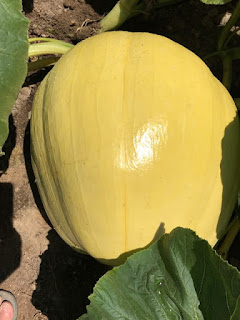
I like the smooth skin on this pumpkin. Shape and color are all from the 282 Scherber side. Almost everything about this plant has looked like the 1725 clone that is the grandparent. It makes me wonder what this plant could have done in better circumstances. Lot of growing left to go however. We are just getting into the fast growing phase, so it will be interesting to see if this plant can make up some for lost time with the warmer nights we are having right now. I'm going to call this pumpkin "Jumbo" since it is from the 747 seed.
The yellow/orange pumpkin is the one on the 1685 Scherber plant. It is growing slow, but picking up some speed. I have another pollination that is 10 days old that I'll probably go with and will take this pumpkin off because the plant was small when it was pollinated and the position on the vine isn't great. 10 day measurements were considerably bigger on the 2nd pumpkin, so we will see what growth looks like over the next few days and then make a decision.


Saturday, June 24, 2017
Last of the Pumpkin Pollinations
Today I did my last pollination of the year. This one was on the 1685 Scherber plant. I hope this one takes, because the other pumpkin on the plant is growing really slow, so I'm hoping this one takes off a little better.


Subscribe to:
Posts (Atom)